

Mines

Zorka Keramika operates two branches: BRANCH KOP DONJE CRNILJEVO, Donje Crniljevo and BRANCH KOP JADRANSKA LEŠNICA, Jadranska Lešnica.

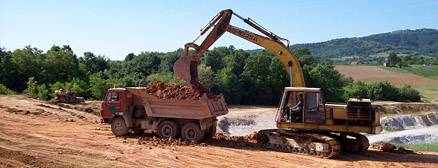
The most significant advantage of our mines is that you can find several types of clay in one place. According to expert analyses, the sites are rich in clay reserves, so exploitation will be possible for the next 15 to 20 years. Since in the first 5-10 m of the excavation there are layers of brick, and underneath there are layers of white ceramic clay, the mines can supply both the brick and ceramic industry with raw material.
All the clays available to Keramika-holding doo are located in the Upper Tamnav Tertiary basin.

According to the mineralogical composition, they represent a mixture of kaolinite-illite-montmorionite clays, which determines their key properties such as: plasticity, casting properties, sensitivity to drying, strength to fracture in the raw state, firing color, etc.

Current products:

  • Yellow-red brick-ceramic clay
  • Gray-white ceramic clay
  • Dark ceramic clay
  • Homogenized clay for ceramic floor tiles
  • Kaolinized granite (as a solvent in ceramic masses)

Use:

  • Rough ceramics : brick industry (brick, tile), ceramic sewer pipes, pottery;
  • Fine ceramics : wall and floor ceramic tiles, sanitary ware;
  • Other uses : paper, rubber, fertilizer and plant protection industry, (achieved by additional processing of raw clays such as crushing, drying, grinding-micronization or ion exchange). A certain proportion of clay is also used in the industry of refractory products, such as firebricks, electrical insulators, etc.

Yellow-red brick-ceramic clay


Basic characteristics of the raw material:
Moisture upon delivery: 17.0 – 19.0 % (depending on the season)
Residue on the 63 µm sieve: 34.8 %

Chemical composition of the raw material:

Component
Loss on ignition
SiO2
Al2O3
Fe2O3
TiO2
CaO
MgO
Na2O
K2O
Content %
4.76
71.06
15.08
5.30
1.00
0.25
0.30
0.14
2.11

Mineralogical composition of the raw material ( Rõ analysis ): the most abundant quartz, minerals of the phyllosilicate group and the smectite group in traces

Properties and behavior in the drying and firing process:

  • water required for plastic processing: 30.25%
  • plasticity according to Pfefferkorn: 33.65%
  • drying shrinkage at 105°C: 6.46%

Clinker temperature:> 1250°C
Sintering temperature:> 1250°C

Use of raw material:
Most in the production of all brick products.

Ignition tests of a flat sample:

TemperatureColor of ignition (CEC)Total. more expensiveWater absorptionAppearance – condition
1250 °CH-9 dark brick red12.64 %7.01 %normal
1170 °CG-10 dark brick red11.48 %11.59 %normal
1100 °CF-10 brick red9.57 %13.92 %normal
1000 °CE-9 darker cream7.49 %18.43 %normal
930 °CE-8 darker cream7.25 %19.11 %normal

Gray-white ceramic clay


Basic characteristics of the raw material:
Moisture upon delivery: 17.0 – 19.0 % (depending on the season)
Residue on the 63 µm sieve: 8.59 %

Chemical composition of the raw material:

Comp.Loss on ignitionSiO2Al2O3Fe2O3TiO2CaOMgONa2OK2O
Content %6.0565.9820.791.881.330.340.750.122.48

Mineralogical composition of the raw material ( Rõ analysis ): the most abundant quartz, minerals of the phyllosilicate group: kaolinite, illite and the smectite group in traces

Properties and behavior in the drying and firing process:

  • water required for plastic processing: 48.80%
  • plasticity according to Pfefferkorn: 54.40%
  • drying shrinkage at 105°C: 9.84%

Clinker temperature:> 1125°C
Sintering temperature:> 1200°C

Use of raw material:
For the production of floor and wall ceramic tiles with a light color of baked “cerepa”.

Ignition tests of a flat sample:

TemperatureColor of ignition (CEC)Ukup. skuplj.Upijanje vodeIzgled – stanje
1250 °CA-5 svetlo-siva19.06 %0.59 %normalan
1170 °CG-10 tamno cigla crvena18.72 %2.79 %normalan
1100 °CF-10 cigla crvena18.35 %7.74 %normalan
1000 °CE-9 tamnije krem13.88 %17.01 %normalan
930 °CE-8 tamnije krem12.06 %20.62 %normalan

Dark ceramic clay


Basic characteristics of the raw material:
Moisture upon delivery: 17.0 – 19.0 % (depending on the season)
Residue on the 63 µm sieve: 5.96 %

Chemical composition of the raw material:

ComponentLoss on ignitionSiO2Al2O3Fe2O3TiO2CaOMgONa2OK2O
Content %12.0950.0829.291.510.701.470.731.780.32

Mineralogical composition of the raw material ( Rõ analysis ): the most abundant quartz, clay minerals and feldspars

Properties and behavior in the drying and firing process:

  • water required for plastic processing: 29.70%
  • plasticity according to Pfefferkorn: 31.70%
  • drying shrinkage at 105°C: 6.50%

Use of raw material:
As a highly plastic raw material, it is used for traditional ceramic products with slow firing processes, as a binder in the production of refractory ceramics and as a filler in various industrial fields.

Ignition tests of a flat sample:

TemperatureColor of ignition (CEC)Ukup. skuplj.Water absorptionAppearance – condition
1100 °CB 2 /B 3 white-beige8.69 %14.71 %normal
1000 °CC 2 /C 3 lightest cream yellow11.00%12.35 %normal
900 °CC 4 darker cream yellow14.06 %9.62 %normal

Homogenized clay for ceramic floor tiles


Basic characteristics of the raw material:
Moisture upon delivery: 17.0 – 19.0 % (depending on the season)
Residue on the 63 µm sieve: 15.0 – 20 %

Chemical composition of the raw material:

ComponentLoss on ignitionSiO2Al2O3Fe2O3TiO2CaOMgONa2OK2O
Content %7.3161.2022.661.140.601.170.640.223.71

Mineralogical composition of the raw material ( Rõ analysis ): the most abundant quartz, clay minerals such as kaolinite, fire clay, illite, montmorionite, then muscovite and feldspars (albite, anorthite)

Properties and behavior in the drying and firing process:

  • water required for plastic processing: 30.57%
  • plasticity according to Pfefferkorn: 32.52%
  • drying shrinkage at 105°C: 7.55%

Use of raw material:
For the production of floor and wall ceramic tiles with a light color of baked “cerepa”.

Ignition tests of a flat sample:

TemperatureColor of ignition (CEC)Total. more expensiveWater absorptionAppearance – condition
1200 °CC 4 darker cream10.77 %0.30 %almost sintered
1100 °CC 4 cream9.49 %3.56 %normal
1000 °CB 3 /C 3 yellowish cream8.85 %9.08 %normal
900 °CC 1 /D 1 light cream5.45 %15.72 %normal
 

Kaolinized granite


Basic characteristics of the raw material:
Moisture on delivery: 6.0 – 8.0 %
Residue on the 63 µm sieve: 75.0 – 85.0 %

Chemical composition of the raw material:

Comp.Gub. ardor.SiO2Al2O3Fe2O3TiO2CaOMgONa2OK2O
Content %3.20 – 4.1063.0 – 66.019.0 – 21.01.50 – 1.650.20 – 0.230.85 – 1.250.20 – 0.301.75 – 2.705.40 – 6.45

Mineralogical composition of the raw material ( Rõ analysis ): mica, quartz, feldspar, calcite/dolomite

Properties and behavior in the drying and firing process:

Clinker temperature:> 1250°C
Sintering temperature:> 1250°C

Use of raw material:
The raw material is used exclusively as the so-called melter in the ceramic industry.

Ignition tests of a flat sample:

TemperatureColor of ignition (CEC)Total. more expensiveWater absorptionAppearance – condition
1200 °CC 4 darker cream5.23 %11.52 %almost sintered
1100 °CF 12 dark brick red2.14 %14.87 %normal
1000 °CE 10 brick red1.05 %17.33 %normal
 

Contact:

ZORKA-KERAMIKA D.O.O.
Beograd-Novi Beograd
Bulevar Mihaila Pupina 10v/114
e-mail: s.djakovac@en.zorka-keramika.rs

Scroll to Top